
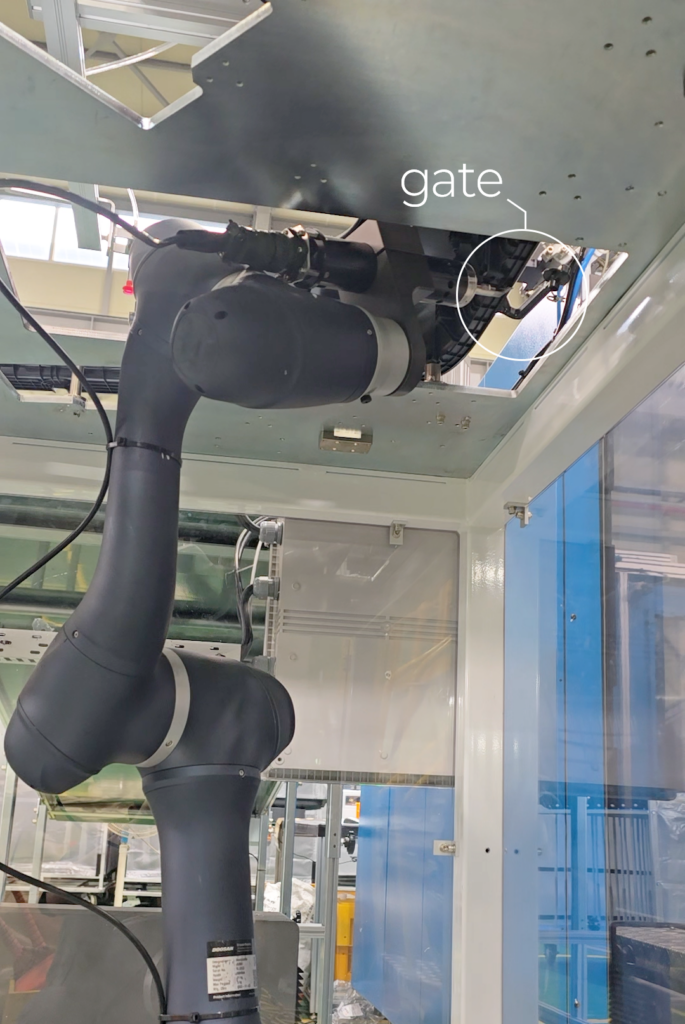
What is Ultrasonic Degating?
Ultrasonic degating is an ultrasonic cutting technology used after injection molding to selectively separate the gate area that
connects the molded product to the runner system.
Unlike conventional mechanical trimming methods, ultrasonic energy is applied to locally heat and soften (or partially melt, if required) the gate area,
enabling cleaner and more stable separation of the molded part.
What is a Runner? In injection molding, a runner is the channel through which molten plastic flows into the mold cavity that forms the product shape.
Why is Ultrasonic Degating Necessary?
In injection molding processes, the runner system is formed together with the product.
To obtain the finished part, the gate connection must be removed.
However, conventional gate removal methods can lead to several issues:
● Rough or uneven cut surfaces
● Mechanical stress applied to the product
● Increased secondary finishing processes
● Reduced production efficiency
Ultrasonic degating is designed to minimize these issues while simultaneously improving post-molding quality and productivity.
Advantages of Ultrasonic Degating
● High-Speed Processing
Gate separation can be completed within a few hundred milliseconds to under one second, depending on conditions.
This makes ultrasonic cutting highly suitable for automating post-molding gate removal processes.
● Clean and Precise Cutting Surface
Because only the gate area is locally heated and softened, the cut surface remains highly precise and uniform, significantly reducing the need for secondary finishing.
For precision components, ultrasonic cutting provides exceptionally clean gate finishing quality.
● Minimized Product Damage
The use of metal blades or nippers is reduced, lowering mechanical stress and minimizing the risk of damage to delicate parts.
This is particularly advantageous for components with thin ribs or sensitive geometries.
● Easy Integration with Automation
Ultrasonic degating can be integrated with mass production systems and automated collection processes.
When combined with robotic handling systems, ultrasonic cutting heads can form a fully automated post-molding processing line.
Applicable Materials
Ultrasonic degating can be applied to a wide range of thermoplastic materials.
It is especially effective for rigid engineering plastics such as PC, PBT, and PA.
Process conditions — including ultrasonic power, time, and applied pressure — may vary depending on material properties and product structure.
Proper process optimization is essential to achieve the best results.
What is Rigidity? Rigidity refers to a material’s ability to resist deformation and maintain its original shape under external force.
Application Examples
Ultrasonic degating is particularly effective for products requiring high aesthetic quality and dimensional precision, such as:
● Automotive interior components
● Electronic device housings
● Medical plastic parts
It is especially valuable when gate marks are exposed on visible surfaces or when secondary finishing must be minimized.
When integrated into automated systems, the process flow can be streamlined into:
Injection molding → Gate removal → Inspection
This makes ultrasonic degating highly suitable for smart manufacturing environments.
Watch the Ultrasonic Cutting Video of an Automotive Door Trim
Core Value of Ultrasonic Gate Cutting
Ultrasonic degating is not merely a method of cutting off gates.
It is a high-efficiency post-molding solution that enhances production speed, reduces secondary processing, ensures stable quality, and enables seamless automation.
MECSTECH Ultrasonic Cutting Solutions
MECSTECH’s ultrasonic cutting systems are engineered to meet all key requirements of ultrasonic degating applications.
Because MECSTECH performs in-house design and manufacturing of ultrasonic cutting equipment, we are able to provide
customized solutions optimized for each product structure and material characteristic.
In addition, we support full automation integration and upstream/downstream process design
to help customers build faster, more stable, and more cost-effective post-molding operations.